Unusual Milan

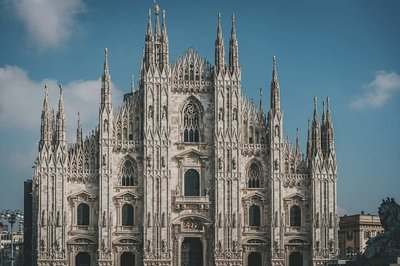
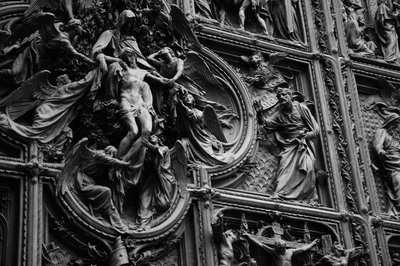
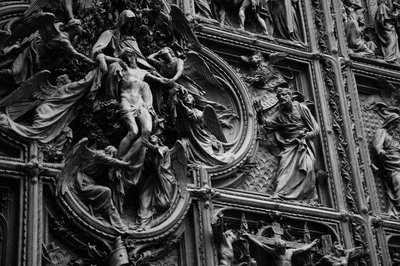
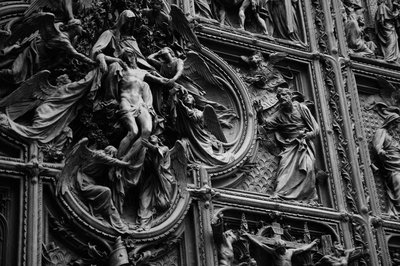
Detail of the bronze doors of Milan Cathedral with intricate black and white sculptures.
Written by travel experts
Regularly updated
Verified on-site

Milan built its global reputation on fashion, finance, and the spectacle of the Duomo, but the city's deepest character lives in places most visitors never find. Beneath the commercial polish lies a labyrinth of crypts, vineyards, and silent neighborhoods where Liberty-style palazzi stand untouched by crowds.

This guide follows a thread that runs from the bone-lined walls of San Bernardino alle Ossa to the sculptural necropolis of the Cimitero Monumentale, through the rationalist villas of the Quadrilatero del Silenzio and into the star-filled dome of Italy's oldest planetarium. Each stop reveals a Milan that existed long before the runway shows, one shaped by medieval pilgrims, Sforza dukes, and the restless experimentation of architects.

What follows are ten experiences for travelers willing to step off the well-worn path between Piazza del Duomo and the Navigli, and discover a city that rewards curiosity with genuine surprise.

Top Things to Do in Milan

The Monumental Cemetery
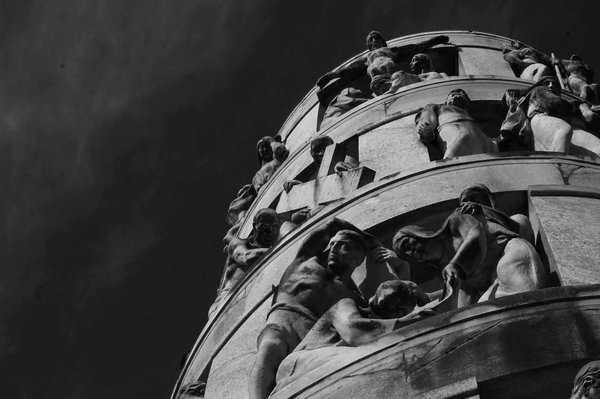
Iconic sculpture at the Monumental Cemetery of Milan in black and white, with intricate details and a dark sky in the background.

Sculpted Memory in Marble and Bronze

When Milan's civic leaders opened the Cimitero Monumentale in , they intended it as the great equalizer, a single burial ground to replace dozens of parish cemeteries scattered across the city. What they created instead was a vast open-air gallery of sculpture, architecture, and civic pride that now stretches across 250,000 square metres. The entrance alone sets the tone: Carlo Maciachini's Famedio, a neo-medieval hall of honor in Carrara marble and Baveno granite, shelters the tombs of Alessandro Manzoni, conductor Arturo Toscanini, and poet Salvatore Quasimodo. Beyond the Famedio, tree-lined avenues radiate outward past Adolfo Wildt's anguished bronzes, Giannino Castiglioni's monumental groups, and a startling concrete cube by Gio Ponti. Styles collide freely: neo-Egyptian obelisks stand beside Art Nouveau angels and brutalist slabs. The cemetery is also a social history of Milanese industry, with entire sections devoted to the families who built the city's silk mills, publishing houses, and railways. A slow morning walk here, away from any admission queue, offers one of the most concentrated encounters with Italian funerary art anywhere in the country.
Located in Piazzale Cimitero Monumentale, in the heart of Milan, a short walk from Porta Garibaldi station.
Open Tuesday to Sunday from 8:00 AM to 6:00 PM. Closed on Mondays.
Entrance is free for all visitors.

Leonardo's Vineyard

Close-up of a bunch of grapes held in hand, symbolizing a vineyard.

A Renaissance Gift Restored

In , while Leonardo da Vinci was finishing The Last Supper on the refectory wall of Santa Maria delle Grazie, Duke Ludovico il Moro granted him a vineyard directly across the street. The gesture was part payment, part diplomatic flattery: Leonardo adored botanical study, and the gift tied the artist more firmly to Milan. The vineyard survived Leonardo's departure but was progressively buried under urban construction until archaeologists and the Portaluppi Foundation undertook a painstaking restoration completed in . Using DNA analysis of root traces found beneath a building, researchers identified the original Malvasia di Candia grape variety and replanted it in the exact rows Leonardo once tended. Today the small walled garden sits inside the Casa degli Atellani, a palazzo whose frescoed halls alone justify the visit. Stepping from the ornate interiors into the quiet green of the vineyard, with the apse of Santa Maria delle Grazie visible above the wall, produces one of Milan's most atmospheric contrasts between Renaissance splendor and living nature. The visit is brief but lingers in the memory long after the palazzo doors close behind you.
Located at Corso Magenta 65, in the historic heart of Milan, directly opposite the Last Supper refectory.
Open daily from 9:00 AM to 6:00 PM.
Entrance ticket: €10. Discounts available for students and groups.

The Crypt of San Sepolcro

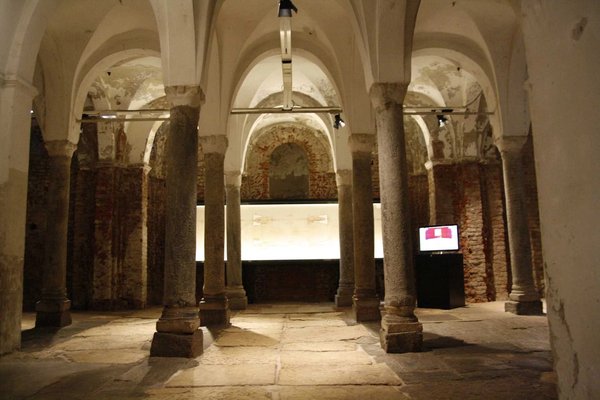
Interior of the Crypt of San Sepolcro in Milan with historic columns and arches.

Milan's Hidden Roman Floor

Descend a narrow staircase beside Piazza San Sepolcro and you drop a thousand years in thirty seconds. The Crypt of San Sepolcro, sealed for decades and reopened to the public only in , sits beneath a church founded in by Archbishop Ariberto d'Intimiano on the site of the ancient Roman forum. The crypt's floor is the original pavement of Mediolanum, the same stones that once felt the footsteps of Emperor Maximian and, centuries later, Saint Ambrose. Rough brick columns support low vaulted ceilings where traces of medieval frescoes survive in patches of faded ochre and blue. Leonardo da Vinci marked this spot as the "vero mezzo di Milano" (the true center of Milan) in his , and a modern installation now projects that notation onto the ancient stone. The atmosphere below ground is cool, dim, and profoundly still, a sharp contrast to the traffic circling Piazza del Duomo just two hundred metres away. Few visitors find this place, which makes the encounter with Milan's deepest archaeological layer all the more striking. Allow at least forty minutes to absorb the silence and the weight of the centuries overhead.
In the heart of Milan, in Piazza San Sepolcro, just steps from the Ambrosiana Library.
Open Tuesday to Sunday, from 10:00 AM to 6:00 PM.
Entrance ticket: €8. Discounts available for students and groups.

Museo del Novecento

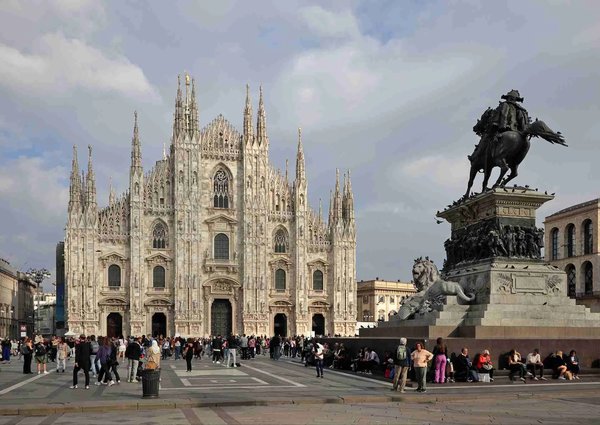
Piazza del Duomo in Milan with the cathedral and the equestrian statue of Vittorio Emanuele II.

Italian Art Above the Duomo

The Museo del Novecento occupies the Arengario, a rationalist building that Mussolini used as a speaking balcony overlooking Piazza del Duomo. Since its reopening as a museum, the space has been transformed by Italo Rota's spiraling ramp, which carries visitors upward through a chronological survey of Italian art beginning with Pellizza da Volpedo's monumental Il Quarto Stato (). The collection's strength lies not in imported blockbusters but in movements that were born or matured in Milan: Futurism is represented by Boccioni, Carrà, and Russolo; Spatialism by an entire room of Lucio Fontana's slashed canvases, lit so the cuts throw actual shadows on the wall behind. A dedicated gallery holds works by Marino Marini, and the top floor opens onto a glass-walled space where Fontana's neon Struttura al Neon () glows against a panoramic view of the cathedral's spires. The museum is free every first Sunday of the month, yet even on those days the upper galleries remain remarkably quiet, offering an unhurried encounter with art that shaped the entire European avant-garde.
In the heart of Milan, at Piazza del Duomo 8, inside the Arengario building.
Open daily from 10:00 AM to 7:30 PM.
Entrance ticket: €10. Discounts available for students and groups.

The Vertical Forest

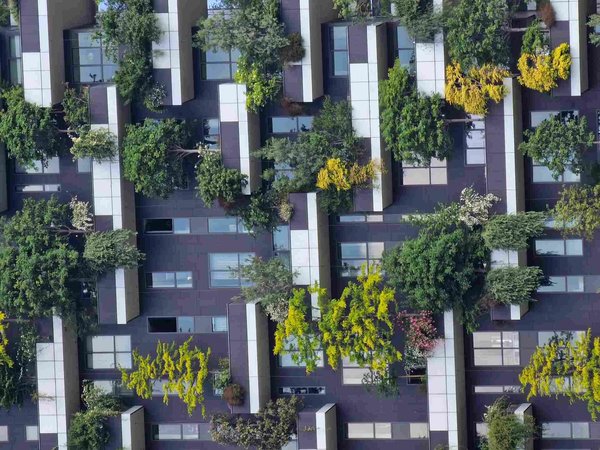
Facade of the Vertical Forest in Milan with plants and trees integrated into modern architecture.

Living Architecture in Porta Nuova

When architect Stefano Boeri unveiled the Bosco Verticale in , skeptics predicted the trees would die and the balconies would crack. A decade later, the twin residential towers, standing 111 and 76 metres tall in the Porta Nuova district, carry more than 900 trees, 5,000 shrubs, and 15,000 perennial plants across their cantilevered concrete terraces, and the vegetation has thickened visibly with every passing year. The design solved a specific Milanese problem: the Po Valley's notorious air pollution. Boeri calculated that the towers' biomass absorbs roughly 30 tonnes of CO₂ per year and filters fine particulates that would otherwise settle on the surrounding blocks. At street level, the effect is immediate. Walking through the tower base in summer, the temperature drops perceptibly and the sound of wind through leaves replaces traffic noise. The project won the International Highrise Award in and has since inspired direct replicas in Eindhoven, Nanjing, and Tirana. For visitors, the exterior and the landscaped park at ground level are freely accessible; the residential floors remain private, but the upward view from the piazza below, where balconies dissolve into a green canopy against the Lombard sky, is among the most unusual urban sightlines in Europe.
In the Porta Nuova district of Milan, at Via Gaetano de Castillia 11, easily accessible from the city center.
Accessible year-round, at any time of the day.
Free visit: admire the exterior and surrounding gardens at no cost.

The House of the Omenoni

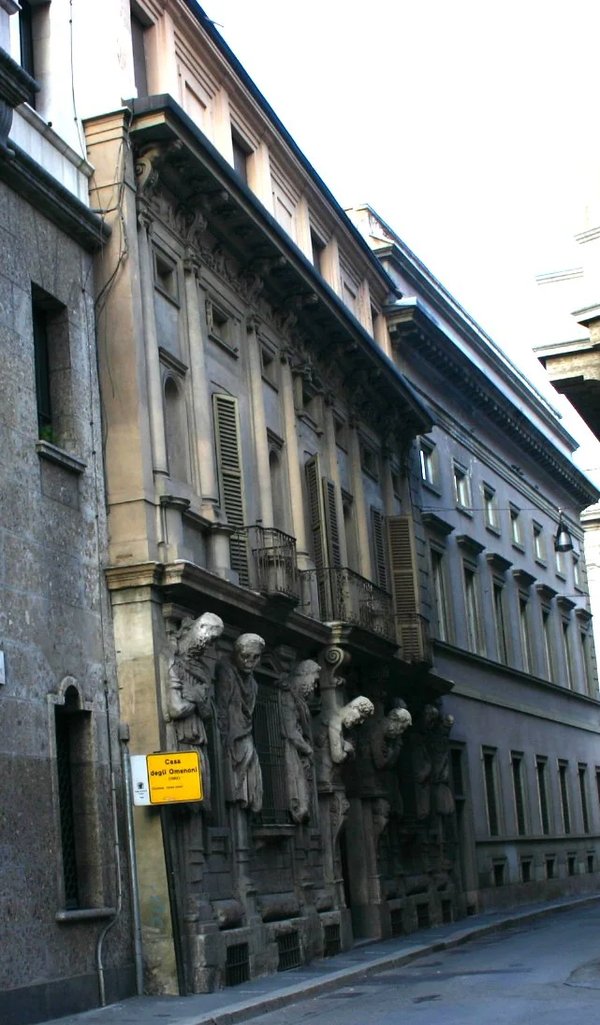
Facade of the House of the Omenoni in Milan with distinctive statues and architectural details.

Eight Giants Guarding a Secret

On a narrow street between Piazza della Scala and Piazza Belgioioso, eight colossal stone figures strain under the weight of a palazzo, their muscles tensed, their faces locked in expressions of suffering. These are the Omenoni, sculpted by Antonio Abondio for the home of Leone Leoni, the court sculptor and goldsmith to Emperor Charles V and Philip II of Spain. Leoni built the house in as both residence and private gallery, filling it with antiquities and paintings, including works by Titian. The giants themselves draw on the tradition of caryatids and atlantes but amplify the drama: each figure is a barbarian prisoner, pressed into architectural service as a display of Leoni's imperial connections. Above the door, a relief shows a lion (a pun on Leoni's name) devouring a serpent, the heraldic biscione of the Visconti. The building is now the private headquarters of the Club degli Omenoni, a cultural society, so the interior remains closed to the public. But the facade alone, compressed into a street barely five metres wide, delivers one of Milan's most startling encounters with sculptural ambition.
Located at Via degli Omenoni, 3, in the historic heart of Milan, just steps from La Scala Theatre.
The facade is visible year-round, at any time of the day.
Free access to admire the exterior.

Museo Poldi Pezzoli

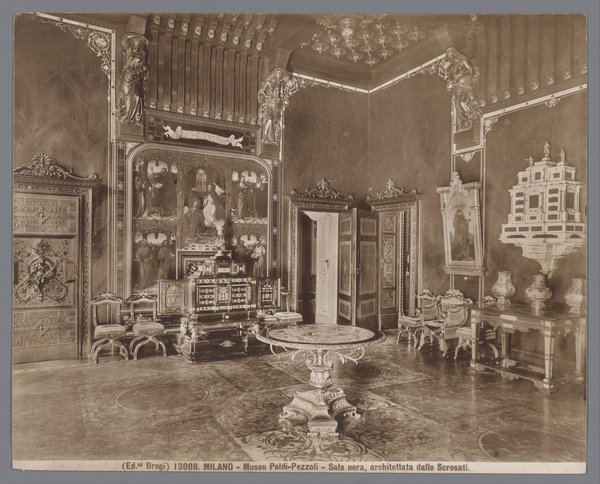
Historic photograph of the Sala Nera at Museo Poldi Pezzoli in Milan, showing Renaissance furnishings and bronzes.

A Collector's Private Universe

In , when the Museo Poldi Pezzoli opened to the public on Via Manzoni, it became one of Europe's first house-museums, a concept that would later inspire the Frick Collection in New York and the Wallace Collection in London. Its founder, Gian Giacomo Poldi Pezzoli, spent three decades assembling a collection that ranged from Lombard armor to Flemish tapestries, Persian carpets, and Murano glass, all displayed in rooms he designed with the help of architect Giuseppe Bertini to evoke specific historical periods. The Sala d'Armi recreates a medieval armory with jousting lances and engraved breastplates; the Sala Nera (Black Room) concentrates on Renaissance bronzes and astronomical clocks. The painting collection, though small, contains masterpieces of staggering quality: Botticelli's Madonna del Libro, Mantegna's Madonna and Child, and Piero della Francesca's haunting profile portrait of a young woman, which has become the museum's emblem. The intimate scale of the rooms, none holding more than a few works, creates a viewing experience closer to a private visit than a public museum, one where you stand alone before a Bellini altarpiece in perfect silence.
Located at Via Alessandro Manzoni 12, in the heart of Milan, just steps from La Scala Theatre.
Open daily from 10:00 AM to 6:00 PM.
Entrance ticket: €14. Discounts available for students and groups.

The Milan Planetarium

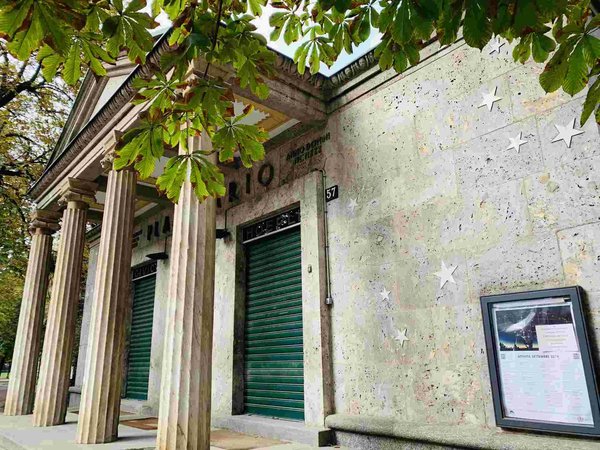
Facade of the Milan Planetarium with columns and star decorations, surrounded by green leaves.

Italy's Oldest Dome of Stars

Donated to the city by publisher Ulrico Hoepli and inaugurated in , the Civico Planetario di Milano is the largest planetarium in Italy and one of the few planetariums still operating with its original Zeiss projector mechanism. The building itself, designed by Piero Portaluppi in a stripped neoclassical style, sits inside the Indro Montanelli Public Gardens near Porta Venezia, its facade marked by a frieze of zodiac symbols that most passersby walk past without noticing. Inside, 300 seats ring a 19.6-metre dome where the projector reproduces the night sky as it appears from any point on Earth at any date in history. Regular programs range from introductory tours of the solar system to specialized lectures on gravitational waves, exoplanet detection, and Milanese astronomical history (the city's Brera Observatory, founded in , was central to European star-mapping). Evening sessions occasionally simulate the sky as it would have looked to Galileo or to navigators crossing the Indian Ocean. Tickets cost a few euros, the dome is never crowded on weekday afternoons, and the surrounding park offers a natural buffer against the city's noise.
In the heart of Milan, at Corso Venezia 57, within the Indro Montanelli Public Gardens.
Open Tuesday to Sunday from 9:00 AM to 5:30 PM. Closed on Mondays.
Entrance ticket: €5. Reduced rates available for children and groups.

San Bernardino alle Ossa

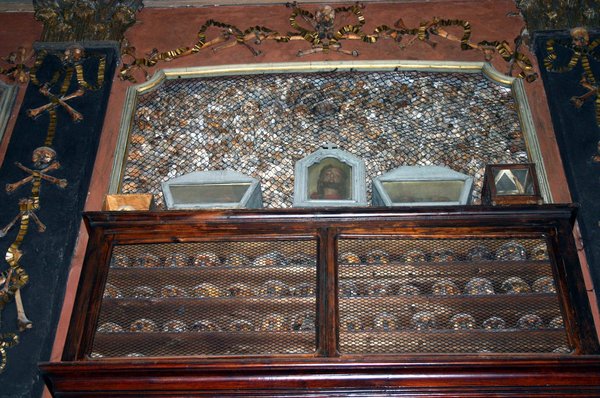
Wall of skulls and bone-crosses inside the ossuary chapel of San Bernardino alle Ossa in Milan.

Milan's Bone Chapel

Behind an unremarkable Baroque facade on Via Verziere, a side chapel in the Church of San Bernardino alle Ossa confronts visitors with walls, columns, and vault panels entirely covered in human skulls and bones arranged in geometric and decorative patterns. The ossuary dates to , when a nearby hospital cemetery ran out of space and bones were transferred to this small room for storage. Over the following centuries, the display evolved from practical necessity into deliberate artistic arrangement: tibias form radiating crosses, skulls line cornices, and smaller bones fill rosette patterns in the plaster. The chapel was rebuilt after a collapse and again after a fire in , each reconstruction adding layers of Baroque ornamentation around the skeletal framework. A fresco by Sebastiano Ricci, depicting the Triumph of Souls in Glory, covers the ceiling directly above the bone walls, juxtaposing heavenly aspiration with earthly remains in a composition that is equal parts devotional and macabre. The church sits just two blocks from the Duomo, yet the ossuary chapel, accessible through a low doorway on the right aisle, receives a fraction of the cathedral's visitors. On , the Feast of All Souls, a special mass is celebrated among the bones.
Located at Via Verziere 2, in the heart of Milan, just steps from the Duomo.
Open daily: from 7:30 AM to 12:00 PM and from 1:00 PM to 6:00 PM.
Entrance is free. A unique opportunity to discover an extraordinary place at no cost.

Quadrilatero del Silenzio

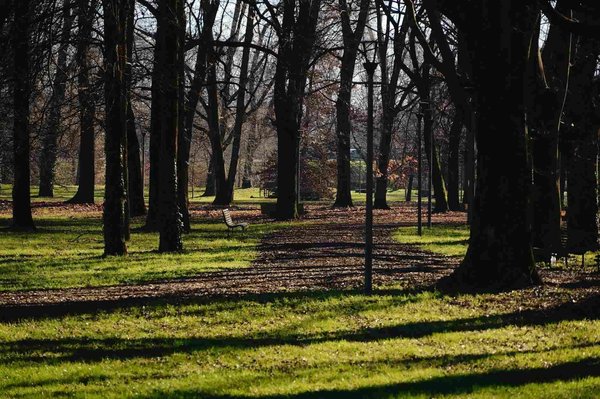
Tree-lined path with benches and light play in the Quadrilatero del Silenzio in Milan.

Art Nouveau Behind Closed Gates

A few blocks east of Corso Buenos Aires, Milan's loudest shopping street, the Quadrilatero del Silenzio unfolds as a network of residential streets so quiet that your footsteps echo off the facades. The district took shape between and , when Milan's industrial bourgeoisie commissioned some of the city's finest architects to build private villas and apartment houses in the Liberty (Italian Art Nouveau) and rationalist styles. Via Mozart, Via Serbelloni, and Via Cappuccini display the full range: wrought-iron balconies shaped as twisting wisteria, polychrome ceramic tile panels, beveled glass transoms, and carved stone cartouches depicting insects and flowers. The crown jewel is Villa Necchi Campiglio, a rationalist mansion by Piero Portaluppi, now a FAI property open to the public, where heated marble floors, a private swimming pool, and a tennis court reveal the domestic luxury of Milan's interwar elite. Nearby, Palazzo Berri-Meregalli on Via Cappuccini flaunts a facade loaded with Gothic gargoyles, Byzantine mosaics, and Adolfo Wildt's tortured sculpture L'Umanità contro il Male above the entrance. The neighborhood remains primarily residential, which is precisely the source of its silence and its appeal.
In the heart of Milan, centered around Via dei Cappuccini, just steps from Porta Venezia.
Accessible daily, at any time.
Free entrance for all visitors.

Recommended Itineraries in Milan

Underground and Ancient Milan

Morning — Begin at the Crypt of San Sepolcro, where you can walk on Roman-era paving stones that Leonardo da Vinci once identified as the true center of the city. From there, cross to Via Verziere and enter San Bernardino alle Ossa to see the ossuary chapel's bone-covered walls in the quiet of early morning, when the church is nearly empty.

Afternoon — Walk to the Basilica di Sant'Ambrogio and descend into its crypt, where the gilded remains of Saints Ambrose, Gervase, and Protase lie in a glass reliquary. End at the Civico Museo Archeologico on Corso Magenta, which preserves a Roman tower and sections of the city walls in its garden.

Liberty Architecture Walk

Morning — Start at Porta Venezia and enter the Quadrilatero del Silenzio along Via Serbelloni, pausing to study the wrought-iron balconies and ceramic tile facades of Milan's finest Art Nouveau residential buildings. Visit Villa Necchi Campiglio (book ahead), Piero Portaluppi's rationalist masterpiece, now open as a house-museum with its original furnishings and heated marble floors.

Afternoon — Cross Corso Buenos Aires to the Casa Galimberti on Via Malpighi, whose entire facade is covered in painted ceramic tiles depicting female figures and garlands. Continue to Palazzo Castiglioni on Corso Venezia, then finish with an aperitivo at a Liberty-era cafe in the Porta Venezia neighborhood.

Navigli to Ringhiera Houses

Morning — Follow the Naviglio Grande canal south from the Darsena basin, exploring the artist studios, antique shops, and small galleries that line the towpath. Stop at the Vicolo dei Lavandai, a tiny alley where a covered stone washhouse from the still stands intact, complete with its original wooden washing boards.

Afternoon — Cross into the Porta Ticinese district and walk through the courtyards of the case di ringhiera, Milan's traditional shared-balcony apartment buildings. These communal corridors, draped in laundry and potted plants, represent a form of working-class architecture unique to Lombardy. End at the Basilica di Sant'Eustorgio, where the Portinari Chapel holds frescoes by Vincenzo Foppa.

When to Visit

The Best Time to Visit Milan

The best time to visit Milan is during spring (April-June) and autumn (September-October), when the weather is mild and pleasant. Summer can be hot and crowded, while winter offers fewer crowds but cooler temperatures.

Peak Season

Summer (June-August) is the peak season, with more tourists and higher prices.

Shoulder Season

Spring and autumn offer a good balance between weather and tourist crowds.

Low Season

Winter (December-February) is the low season, with fewer tourists and more affordable prices.

Tips for Visiting Milan

Visit the Saturday morning market on Via Fauche near Porta Garibaldi for produce, cheese, and vintage clothing at local prices, well away from tourist foot traffic.
Explore Parco delle Cave in western Milan, a former quarry site transformed into a chain of lakes and woodlands where herons nest and locals jog in near-total quiet.
Book an evening performance at Teatro Franco Parenti in the Porta Romana district, one of Milan's most experimental stages for contemporary drama and dance.

Local Experiences in Milan

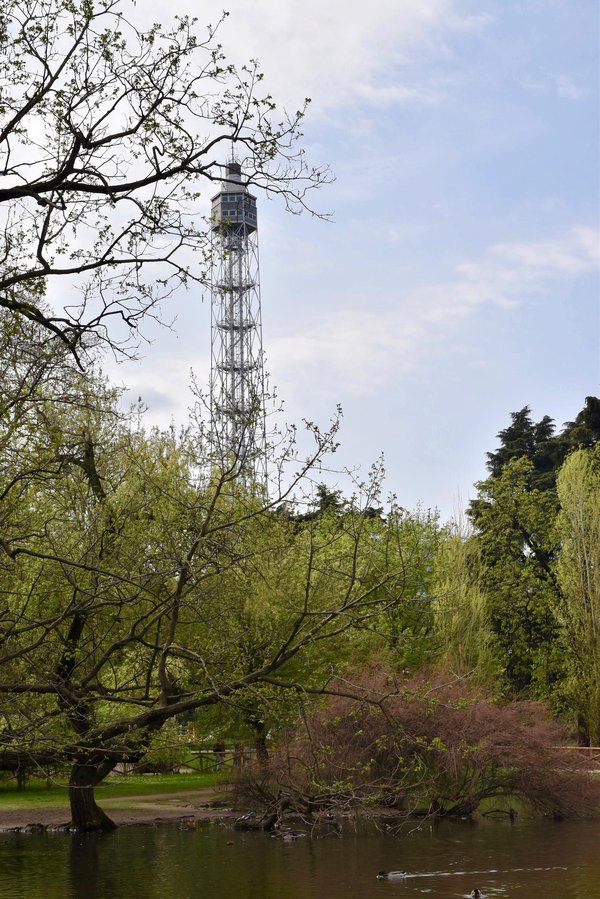
Torre Branca observation tower rising above the trees of Parco Sempione in Milan.

Explore Parco Sempione

Parco Sempione stretches between the Castello Sforzesco and the Arco della Pace, covering 47 hectares of lawns, gravel paths, and old-growth trees planted when the park was laid out in . Inside the grounds you will find the Civico Acquario, a Liberty-style aquarium building from , and the Torre Branca, a slender steel observation tower designed by Gio Ponti. On weekday mornings the park is quiet enough to hear woodpeckers in the plane trees.
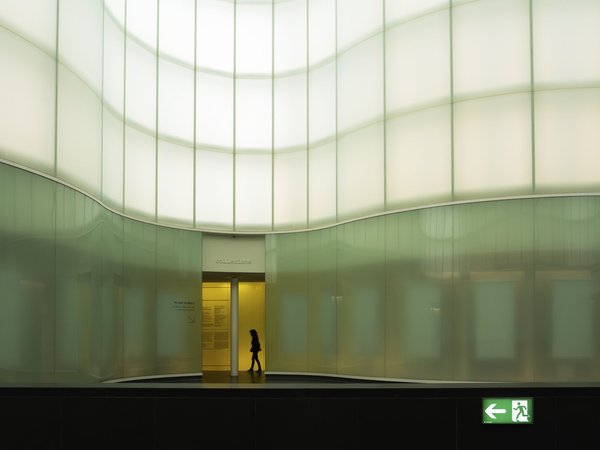
Translucent glass-panel courtyard of MUDEC, Milan's Museum of Cultures, with a visitor silhouetted in the entrance.

Discover MUDEC
The Museo delle Culture (MUDEC), designed by David Chipperfield and opened in , occupies a converted factory in the Tortona-Solari district. Its permanent collection draws on 7,000 ethnographic objects amassed by Milanese collectors during the , while the temporary exhibition hall hosts traveling shows that have ranged from Frida Kahlo retrospectives to immersive digital art installations. The museum's internal courtyard, roofed in translucent panels, is one of Milan's most striking contemporary architectural spaces.
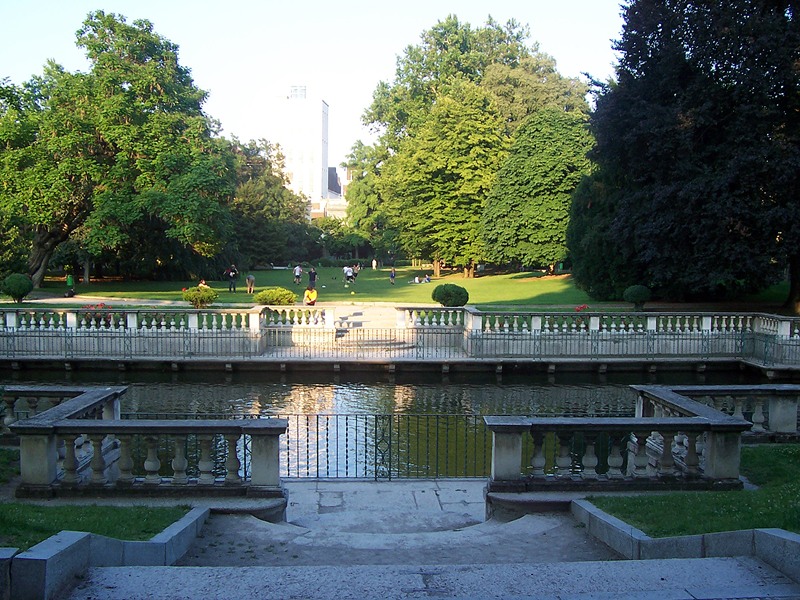
Baroque fish pond flanked by a stone balustrade in the Giardino della Guastalla in Milan.

Visit the Guastalla Garden

The Giardino della Guastalla, founded in by Countess Ludovica Torelli as part of a girls' college, is one of Milan's oldest surviving gardens. Its Baroque fish pond, flanked by a stone balustrade and shaded by magnolias and plane trees, sits just behind the Palazzo di Giustizia yet feels entirely removed from the surrounding traffic. The garden is small enough to cross in five minutes but rewarding enough to linger in for an hour with a book.

Frequently Asked Questions about Milan

What is the best time to visit Milan?

I recommend spring (<time datetime="2026-04">April</time> to <time datetime="2026-06">June</time>) and early autumn (<time datetime="2026-09">September</time> to <time datetime="2026-10">October</time>). Temperatures hover between 16 and 25 degrees, the parks are in full leaf, and most museums operate extended hours. Summer brings heat and humidity from the Po Valley, and many Milanese leave the city in August.

Is Milan a safe city for tourists?

I have always felt safe walking Milan's streets at any hour. The city center and metro system are well-lit and well-patrolled. Standard precautions apply in crowded spots like the Duomo and Centrale station: keep bags zipped and phones pocketed. The neighborhoods in this guide, especially the Quadrilatero del Silenzio and the Monumental Cemetery, see very few incidents.

What are the most convenient means of transport in Milan?

I rely mostly on the metro, which has four lines covering the center and major hubs. A single ticket costs 2.20 euros and is valid for 90 minutes across metro, tram, and bus. For reaching the Navigli or the Quadrilatero del Silenzio, the vintage tram lines are both practical and scenic. BikeMi, the city's bike-sharing system, has stations every few hundred metres and works well for short hops between sites.

Where can I find typical Milanese food?

I suggest heading to the trattorias around the Navigli and the Porta Ticinese district for classic dishes: risotto alla milanese with saffron and bone marrow, cotoletta alla milanese (a thick veal cutlet, not to be confused with a Wiener Schnitzel), and cassoeula, a slow-cooked pork and cabbage stew served in winter. For panettone, the bakeries Marchesi and Cova have been producing it since the 19th century.

What are the lesser-known attractions in Milan?

Beyond the sites in this guide, I would add the Isola district behind Porta Nuova, where street art covers entire building facades; the Orto Botanico di Brera, a small botanical garden hidden behind the Pinacoteca; and the Fondazione Prada, a contemporary art complex built inside a former gin distillery in the Largo Isarco area.

Is Milan a family-friendly city?

I have seen families enjoy the Planetarium, Parco Sempione, and the Civic Aquarium without the queues that plague Rome or Florence. The Museo della Scienza e della Tecnologia Leonardo da Vinci, Italy's largest science museum, has hands-on exhibits that keep children engaged for hours. Most restaurants welcome families, and gelaterias are never more than a block away.

What are the best neighborhoods for shopping in Milan?

The Quadrilatero della Moda (Via Montenapoleone, Via della Spiga) is the luxury district. For more varied and affordable shopping, I prefer Corso Buenos Aires, one of Europe's longest shopping streets, and the Brera neighborhood for independent design shops, vintage boutiques, and small art galleries.

Where can I find contemporary art in Milan?

I always start at the Fondazione Prada, where Rem Koolhaas converted a distillery into one of Europe's most ambitious private art spaces. The Triennale di Milano in Parco Sempione focuses on design and architecture exhibitions. For emerging artists, the galleries clustered around Via Ventura in the Lambrate district hold open evenings that are worth timing your visit around.

What are the best markets in Milan?

I visit the Fiera di Sinigaglia along the Naviglio Grande on Saturdays for vintage clothing, vinyl records, and antique furniture. The Via Fauche market near Porta Garibaldi is excellent for fresh produce and local cheeses. On Tuesdays and Saturdays, the Viale Papiniano market draws a mixed crowd for household goods and leather accessories at fair prices.

Is Milan an expensive city to visit?

I find Milan comparable to other major European capitals, but there are reliable ways to spend less. Many museums offer free entry on the first Sunday of the month. Lunch menus at trattorias away from the Duomo cost between 12 and 18 euros for a full meal. The aperitivo tradition, where bars serve generous buffets with the price of a drink, effectively replaces dinner for many locals and visitors.